Most SEO guides tell you to find keywords with high search volume and low difficulty using standard keyword research tools, then stuff them into your content. That approach worked in 2012.
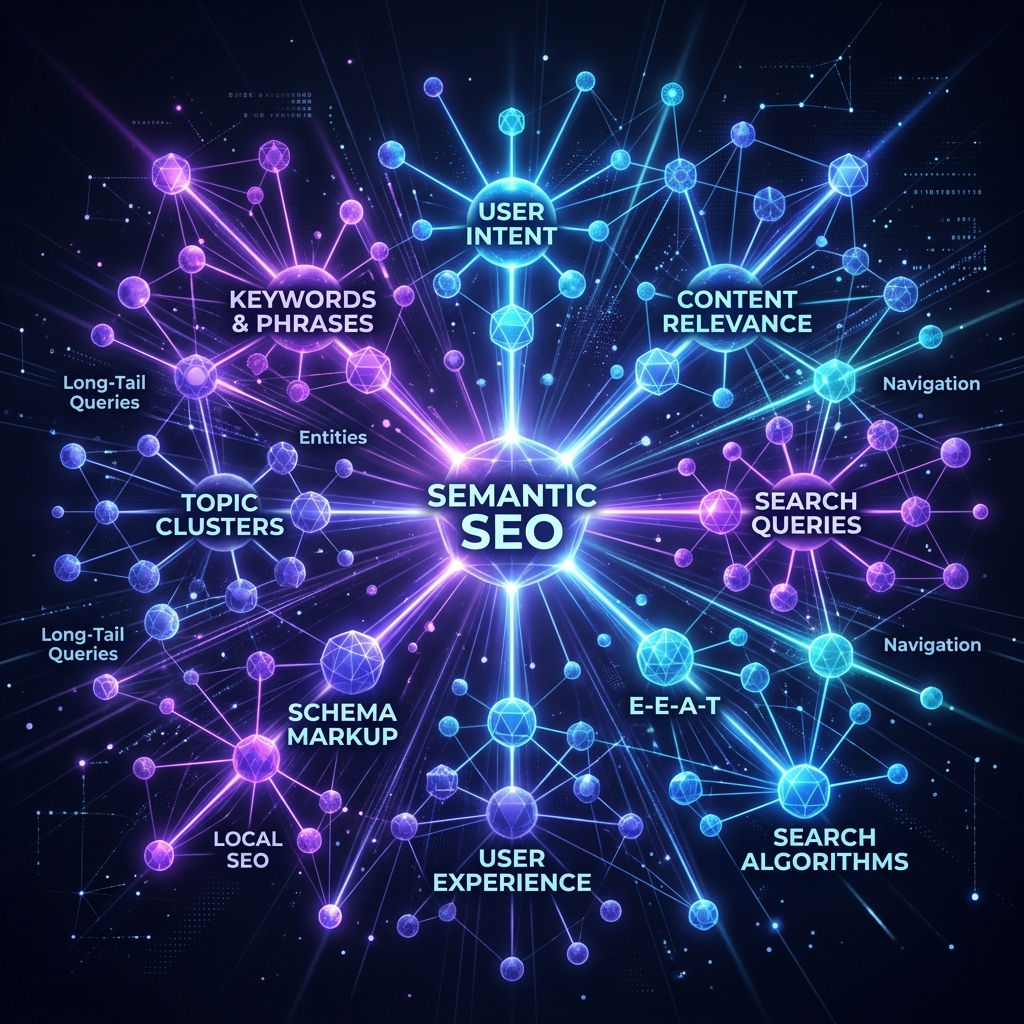
Google today does not rank pages. It ranks semantic networks — interconnected clusters of content that together prove your expertise on a subject (often built using semantic triples).
At the center of this shift is a concept most marketers have never heard of: correlative keywords (also called correlative queries).
This is not a synonym for "related keywords" or "LSI keywords." It is a specific, mathematically defined type of query relationship that directly shapes how Google decides what your content is about — and whether your page deserves to rank.
In this guide, you will learn:
- The precise definition of correlative keywords (and how they differ from sequential queries)
- The Google patents that prove why they matter
- How to find them for your specific business
- A real-world funnel example using a Google Business Profile optimization service
- What to do (and avoid) before you start any SEO campaign
What Are Correlative Keywords in SEO?
Correlative keywords are two or more distinct search queries that a statistically significant number of users search within the same session, regardless of which query comes first.
The critical word is regardless. Whether a user searches "GBP optimization checklist" and then "how to rank higher on Google Maps" (often heavily influenced by direction requests) — or does it in reverse — Google sees both queries as contextually linked. They are facets of the same underlying intent.
Here is the formal definition from semantic SEO research:
"Correlative queries are distinct search queries that are frequently executed together within the same search session by a statistically significant portion of the user base, regardless of the sequential order in which they are typed."
A Simple Example
Imagine 10,000 users are searching Google in a single week. Among those sessions:
- 7,400 users who search "best CRM software" also search "CRM pricing comparison" in the same session
- 6,900 users who search "hiking gear" also search "best outdoor hikes" in the same session
Google does not see these as separate interests. It sees them as co-occurring facets of a single intent cluster. The correlation coefficient between these query pairs exceeds Google's internal threshold — so the algorithm binds them conceptually.
Your content must reflect this binding. A page about "best CRM software" that does not address pricing comparisons is, algorithmically, an incomplete document.
Correlative Keywords vs. Sequential Keywords vs. Query Paths
This is the distinction almost every SEO blog gets wrong. These three concepts are fundamentally different, and confusing them leads to broken content architecture.
| Concept | Definition | Order Dependent? | Content Application |
|---|---|---|---|
| Correlative Queries | Queries searched together in the same session | ❌ No | Determines the horizontal breadth of a single page |
| Sequential Queries | Queries that build upon each other as intent narrows | ✅ Yes | Determines the vertical depth of your content cluster |
| Query Path | The full macro-journey a user takes from awareness to decision | ✅ Yes | Determines your site architecture |
Why This Distinction Matters
When you see "People Also Ask" and "Related Searches" on a SERP, you are not seeing correlative queries in a raw form. You are seeing Google's rendered output of a much deeper statistical analysis of session co-occurrence data.
Scraping those boxes and plugging them into H2 tags is not correlative keyword optimization. It is surface mimicry.
Real correlative keyword optimization means understanding why those queries are linked — and structuring your content so that when Google parses it for entities and attributes, it finds every expected concept present.
The Mathematical Foundation (Why Google Cares)
Google uses statistical models — specifically Spearman correlation coefficients — to measure the strength of the relationship between queries in session logs.
Spearman correlation is preferred over Pearson here because user behavior is not perfectly linear. It evaluates whether one factor tends to increase as another does, even when the relationship is not a straight line. In practice, this means Google can detect that users who search for "Google Business Profile not showing" tend to also search for "how to fix GBP suspension" without needing a perfect 1:1 relationship.
When the correlation coefficient between two queries crosses an internal threshold, Google binds them into the same semantic cluster. From that point, a document must address both queries — not optionally, but as a structural requirement for topical completeness.
The Anomaly Problem
Pure statistical correlation is not enough. Early data from Google Correlate (a now-discontinued tool) showed bizarre anomalies: "inbound marketing" correlated statistically with searches for a cholesterol medication. "404 page" correlated with a specific closed college campus.
These anomalies are why Google layers entity recognition and Natural Language Processing on top of raw correlation data. Statistical proximity alone does not equal semantic relevance. Both must be present.
The Google Patents Behind This
Two specific Google patents confirm that correlative query behavior is engineered directly into the ranking algorithm. Most SEO blogs never cite these.
Patent US7818315B2 — Re-Ranking Based on Query Logs
This patent details how Google re-ranks search results based on co-occurring queries in session logs.
The system uses a "Query Log Component" that captures queries submitted within a user's search session. It builds a probabilistic language model from:
- Queries that contain the target query as a substring
- Queries with high lexical overlap
- Queries that frequently precede or follow the target query in a session
The practical implication: If a user searches "hard disk case" but the standard industry term is "hard drive enclosure," Google's co-occurrence data allows it to bridge that lexical gap. It re-ranks results using cosine similarity scores derived from the correlative query cluster — not the exact words on the page.
This is why exact-match keyword stuffing is increasingly irrelevant. Google knows what your page is about based on what users search before and after finding it.
Patent US8051076 — Demotion of Repetitive Results
This patent explains what happens when your content is too similar to a competitor's.
When a user searches Query A, skips the results, and immediately searches Query B (a correlative query), Google interprets this as dissatisfaction. It actively demotes sites that appeared in the first search from the second — to introduce diversity.
The algorithm calculates a "relevancy threshold" — the point where a document is still relevant enough to show but not so dominant it monopolizes correlative searches.
The practical implication: If your page mirrors the same structure and information as the top 10 competitors, you will eventually be caught in this demotion loop. Information gain — something genuinely new or uniquely synthesized — is not optional. It is the mechanism that keeps you from being filtered out.
A Real-World Correlative Keyword Funnel (GBP Optimization Example)
This is what a properly mapped correlative keyword funnel looks like in practice. Rather than grouping synonyms, this maps the statistical journey of two distinct audiences across four intent stages.
The service in this example is Google Business Profile (GBP) Optimization.
Stage 1: Awareness (Problem-Focused)
Users at this stage do not know what GBP optimization is. They are searching for symptoms.
- Business Owner Path: "Why is my business not showing up on Google Maps" or "How to get fake Google reviews removed"
- Local SEO Expert Path: "Google Business Profile bulk upload error codes" or "How to manage 100+ local clients efficiently"
Intent: Frustration (Business Owner) or Operational bottleneck (Local SEO Expert). They want an immediate fix or need scalability.
What this means for your content: A page targeting GBP optimization must contain entity attributes that address both of these problem clusters — not in separate tabs or pages, but within the document's core semantic structure. Google sees these as co-occurring facets of the same service category.
Stage 2: Consideration (Solution-Focused)
Users now understand the root cause is their GBP setup. They are evaluating DIY versus outsourcing.
- Business Owner Path: "Google Business Profile optimization checklist 2026" (referencing top local search ranking factors) or "How to rank higher in local map pack"
- Local SEO Expert Path: "White label local SEO audit template" or "Best local rank tracking software API"
Intent: Educational or structural. Can I fix this myself, or do I need specialized outsourcing systems and automation tools?
What this means for your content: Sequential queries at this stage dictate your cluster architecture. The checklist query belongs on its own page, linked internally from your GBP service page. The "white label" query suggests a separate audience segment that may need its own landing page.
Stage 3: Conversion (Transactional)
Users have decided to hire someone. They are now comparing providers and checking credibility.
- Business Owner Path: "Google Business Profile management service pricing" or "Local SEO agency near me reviews"
- Local SEO Expert Path: "White label GBP optimization fulfillment partner" or "Freelance local SEO specialists for hire"
Intent: Commercial (Business Owner) or B2B Partnership (Local SEO Expert). They want an affordable, trustworthy partner, or execution capacity without building an internal team.
What this means for your content: Your service page schema, pricing section, and trust signals (reviews, credentials, case studies) must be present at this stage. This is where your verified GBP entity, Google Knowledge Panel, and local reviews carry weight beyond the page itself.
Stage 4: Post-Purchase (Retention and Upsell)
Once a client is on board, their query behavior shifts to next-step expansion. These queries signal upsell opportunities.
- Business Owner Path: "Local service ads setup guide" or "Best review generation software for small business"
- Local SEO Expert Path: "How to pitch local SEO retainers to clients" or "Automated client reporting dashboards for local SEO"
Intent: Expansion or client retention. The profile is fixed — now they want growth, retainers, and dynamic reporting to prove ROI.
What this means for your content: These post-purchase queries are your retainer and upsell content targets. Blog posts answering these questions — published on your own domain — keep clients engaged and deepen topical authority.
Uses of Correlative Keywords in SEO
Understanding correlative keywords unlocks four practical applications:
1. Page Architecture Decisions
Correlative queries define the horizontal breadth of a single page. If your page targets "GBP optimization," it must also contain content addressing fake review removal, map pack rankings, and profile suspension — because users search these together. Missing any of them signals incompleteness to the algorithm.
2. Internal Linking Strategy
Sequential queries (intent refinements after the initial search) define where you need separate cluster pages — and how to link them together. A user who searches "GBP optimization checklist" and then "how to add products to GBP" is showing you the exact internal link path your site needs. Understanding the importance of internal linking for SEO helps you distribute page authority effectively.
3. Content Gap Analysis
When you extract correlative query clusters from Google Search Console and see queries getting impressions but zero clicks, those are the attributes your page is recognized for but not delivering on. Each of those queries is a missing section.
4. GEO (Generative Engine Optimization)
When an AI like Gemini or ChatGPT answers a user query about GBP optimization services in Kerala, it fires multiple internal sub-queries to gather context before responding. If your content only covers the broad "GBP optimization" topic without addressing the specific attributes those sub-queries target, your brand will not be cited — even if you rank on the traditional SERP. Learn how to adapt in the AI Search / GEO era and optimize your listings for Ask Gemini 2026.
How to Find Correlative Keywords for Your Business
Method 1: Google Search Console API + Regex Filtering
The standard GSC interface shows 1,000 rows and redacts a significant portion of queries. For real correlative keyword mapping, you need to extract via the Search Analytics for Sheets add-on (tens of thousands of rows) and apply regex filters. If you're new to the platform, review our Google Search Console tutorial.
To isolate informational intent queries that users associate with your core entity, use:
/\b(how|what|why|when|where|can|do)\b
To surface the comparison queries that define your MOFU (middle-of-funnel) content needs, use:
.*(best|alternat|vs|versus|review|compar).*
Merge this GSC data with GA4 engagement metrics in Looker Studio. A page that ranks for a query but has a high exit rate is failing to address a correlative query users expect to find answered there.
Method 2: SERP Feature Reverse Engineering
For each primary keyword you target, manually analyze:
- "People Also Ask" (the questions users search within the same session)
- "Related Searches" at the bottom (often the strongest correlative signals)
- "People Search Next" (sequential refinements after clicking a result)
Do not just collect these. Map them: which ones belong on the same page (correlative) versus which ones need their own cluster page (sequential)?
Method 3: Knowledge Graph + Wikidata Research
For entity-rich topics, extract the attribute network from Wikipedia and Wikidata. Every entity in Wikidata has structured properties (P-values) that describe its relationships with other entities. These structured relationships often mirror the correlative query clusters Google uses — because Google's Knowledge Graph is built on similar entity-attribute modeling.
For example, searching Wikidata for the entity "Google Business Profile" surfaces related entities: local SEO, Google Maps, business listings, NAP consistency, review management. These are not keyword suggestions — they are algorithmically established attribute relationships that your content must reflect.
Things to Consider Before Starting Any SEO Campaign
Before you map correlative queries or build content clusters, these foundational elements must be in place:
1. Entity Establishment
Google must understand who you are before it can understand what you write about. Your business entity should be:
- Structured with JSON-LD schema (Person, ProfessionalService, LocalBusiness)
- Consistent across your GBP, website, and Wikidata record
- Reflected in a verified Google Knowledge Panel
Without entity clarity, correlative keyword optimization has no anchor. Google cannot assign topical authority to an entity it has not recognized.
2. Technical Crawlability
Correlative keyword strategy requires Google to read your full content — not a JavaScript-rendered shell. Ensure:
- Critical content is not behind JS rendering
- Your robots.txt allows major crawlers (including AI crawlers like GPTBot, ClaudeBot, PerplexityBot)
- Page speed is not preventing complete crawl
3. Topical Map Before Single-Page Optimization
Do not optimize individual pages in isolation. Build your topical map first — identify the central entity, its correlative clusters, and its sequential depth — then write pages in the order that fills the most critical semantic gaps first.
A single well-optimized GBP service page surrounded by weak or missing cluster content will underperform versus a moderately optimized page within a complete topical network.
4. Information Gain Over Completeness
Covering every correlative query is necessary but not sufficient. Google's demotion algorithms actively filter content that mirrors competitor structure without adding new information.
Every piece of content in your semantic network must contribute something the existing top-ranking pages do not: proprietary data, a unique local angle, a specific case study, or a synthesized insight no competitor has published.
5. Publishing Velocity (Momentum)
If your topical map reveals 40 cluster pages needed for full Vastness, but you can only publish 2 per month, your network will remain incomplete long enough for a competitor to overtake you. Either increase publishing frequency, narrow the topical scope, or deepen the sequential layer of existing content while you build out.
Conclusion
Correlative keywords are not a content trick. They are a window into how Google algorithmically models human knowledge.
When you understand that search sessions — not individual searches — are the unit of analysis, everything about SEO strategy changes. Your pages stop being isolated documents and become nodes in a semantic network. Your internal links stop being afterthoughts and become intent pathways. Your content gaps stop being guesses and become mathematically identifiable missing attributes.
The brands and consultants who will dominate local SEO in Kerala and GCC markets over the next five years will not be those who write the most content. They will be those who build the most complete, entity-coherent semantic networks — networks that satisfy not just today's Google, but the sequential sub-queries of AI systems making citation decisions on behalf of millions of users.
That process starts here: map the correlative cluster first. Then build.
Have questions about building a correlative keyword strategy for your local business or client portfolio? Contact Sanoop Balan →