Quick Answer: To rank in Google's Local 3-Pack in Kerala, you must optimize for three core pillars: Relevance, Distance, and Prominence. However, standard Western SEO advice fails here. In Kerala's highly dense, multi-town commercial corridors (like MG Road in Kochi or SM Street in Kozhikode), distance between competitors is often identical. Therefore, the tiebreaker is determined by localized prominence and conversational relevance: fixing misconfigured primary categories, capturing hyper-local landmark data, executing localized citation loops, and generating high-density semantic reviews via WhatsApp.
1. What the Local 3-Pack Actually Is (And Why Kerala is Different)
When someone in Kochi, Kozhikode, or Trivandrum searches for a business on their phone, Google does not display standard blue website links first. It renders a map accompanied by three highly coveted physical business listings. This is the Local 3-Pack.
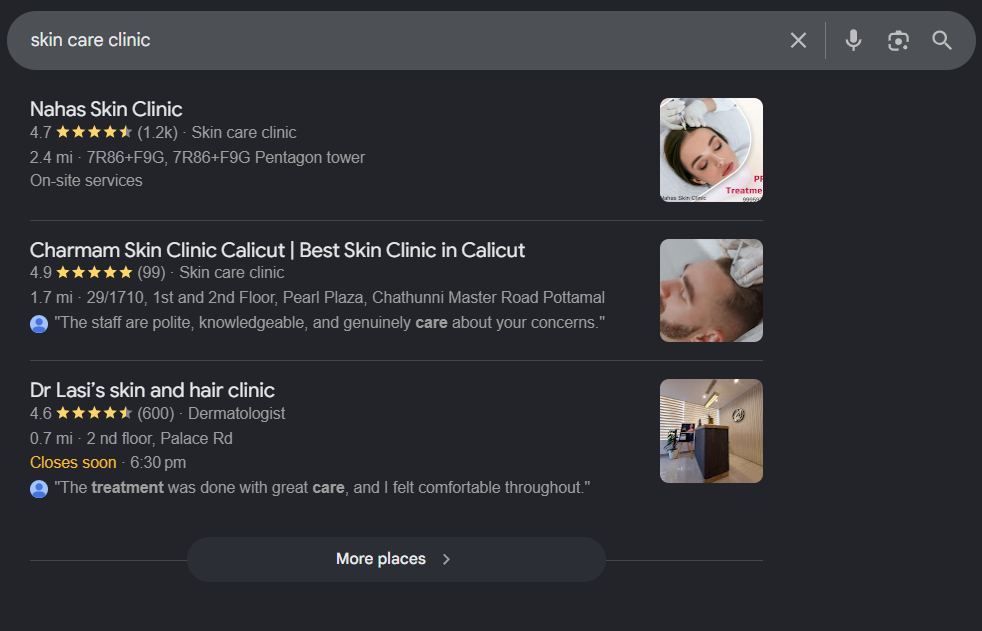
Figure: A real-world example of a Google Maps Local 3-Pack search page layout in Kerala, showing top-ranked skin care clinics.
In Kerala's hyper-dense geography, the local pack maps out consumer demand. If your business is locked into these three spots, you capture the vast majority of direction requests, phone calls, and walk-ins. Everything ranked below the 3-Pack is competing for scraps.
Winning these spots is not a game of chance. Google runs an extraction engine that grades your business entity based on its proximity, authority, and real-world utility.
Because commercial setups in Kerala are tightly clustered, standard optimization isn't enough to stand out. You must engineer your digital profile to match the unique linguistic and structural landscape of the local market.
2. The Real Signals: How Google Chooses the Top 3
Google calculates local rankings using three fixed structural variables:
- Relevance: How accurately your profile data matches the hidden intent behind a search query.
- Distance: The physical distance between the searcher’s mobile GPS coordinates (or targeted landmark) and your mapped storefront pin.
- Prominence: The digital footprint and trust score of your business across the web, driven by reviews, citations, and structural web data.
The Kerala Tiebreaker Formula
In commercial hubs like Palarivattom (Kochi) or Nadakkavu (Kozhikode), dozens of competing businesses sit within a one-kilometer radius. Because the Distance score among these competitors is practically identical, Google's algorithm forces a tiebreaker using Relevance and Prominence.
If your categories are mismatched or your profile lacks ongoing engagement signals, the algorithm will skip your profile and rank a competitor who has correctly optimized their local footprint.
3. Step-by-Step: The 4 Stages to Algorithmic Dominance
To build a profile that commands the map pack, you must systematically optimize through four critical stages of data structuralization.
Stage 1: The Primary Category Correction (The Highest Leverage Fix)
The single biggest algorithmic mistake business owners make across Kerala is choosing a generic taxonomy category instead of a precise business entity. Google treats your Primary Category as the ultimate indicator of relevance. If this field is misconfigured, your profile will remain invisible for high-intent searches.
❌ The Common Mistake: Generic Classification
- Example A: An authentic Arabic restaurant in Kozhikode sets its primary category to "Restaurant".
- Example B: A specialized orthodontic clinic in Kochi sets its primary category to "Clinic".
The Forensic Fix: Exact Service Ingestion
When you use a generic term, you force your profile to compete with every single eatery or medical facility in the district. The moment you update the classification to match your core offering, your visibility shifts instantly:
| Initial Profile State | The Expert Correction | Immediate Algorithmic Result |
|---|---|---|
| "Restaurant" | "Arabic Restaurant" | Ranks #1 for Mandi, Shawarma, and Al Faham queries because the primary category matches the exact culinary intent. |
| "Clinic" | "Dental Clinic" or "Orthodontist" | Triggers map inclusion for high-value services like braces, teeth alignment, and root canals. |
(To understand the compliance risks of over-optimizing your setup data, read my guide on Common Google Business Profile Violations in India).
Stage 2: Optimizing for Malayali Search Behavior & Intent
To capture local traffic, you must stop optimizing for textbook English keywords and start optimizing for how people in Kerala actually use their phones.
1. The Power of "Manglish" and Multilingual Searches
Most users across Kerala rarely switch to a native Malayalam keyboard layout when performing local searches. Instead, they seamlessly combine English characters with Malayalam phonetic terms (Manglish). Google's system easily bridges the gap between these search styles, meaning your digital assets must be prepared to capture all three common search patterns:
- Pattern A (Pure English): "dentist kozhikode"
- Pattern B (Pure Malayalam): "ദന്ത ഡോക്ടർ കോഴിക്കോട്"
- Pattern C (Manglish Blend): "dental clinic കോഴിക്കോട്" / "pallu doctor near me"
2. Purpose-Driven vs. Category-Driven Intent
Malayalis generally search for the immediate solution to their problem rather than the formal name of a professional designation. Intent consistently beats taxonomy:
- Textbook Search: "Orthodontist Calicut" → Real-World Search: "braces doctor calicut", "teeth alignment near me", "invisible braces".
- Textbook Search: "Gastrologist Kochi" → Real-World Search: "vayaru doctor kochi", "stomach specialist hospital".
3. Hyper-Local Geographies and Landmark Anchors
Searchers in Kerala do not look for services broad-scale at a state level; they look for entries tied directly to junctions, colonies, business landmarks, and transport hubs.
- Landmark Anchors: "near Hilite Mall" / "near Medical College" / "near Lulu Mall"
- Junction Anchors: "palarivattom junction" / "mavoor road" / "nadakkavu"
These highly specific location phrases cannot be stuffed into your business name without risking a suspension. Instead, they must be naturally integrated across your digital footprint:
<!-- Integration Strategy for Web Ingestion -->
<p>Our clinic is located just two minutes away from <strong>Mavoor Road</strong>, making it easily accessible for patients traveling from the <strong>Kozhikode KSRTC Bus Stand</strong> or past <strong>Baby Memorial Hospital</strong>.</p>
You can build this local context naturally into your landing pages, FAQ sections, driving direction descriptions, and regular updates.
Stage 3: The Kerala Citation Hierarchy (Quality Over Volume)
A major error committed by general marketing guides is advising business owners to push their information out to hundreds of international directory sites. Directories like Yelp or yellowpages.com carry virtually zero authority or traffic within India.
For a business operating in Kerala, local authority is built through a structured, highly focused tier system:
The Core Rule of Citation Value: Before spending time or money creating a business listing on any directory, ask yourself: "Would a real customer in Kerala actually discover my business through this platform?" If the answer is no, skip it. Focus your efforts on maintaining absolute consistency across high-authority regional networks (see my curated list of business listing and GBP directory sites) instead of accumulating empty directory listings.
Stage 4: The WhatsApp Semantic Review Strategy
Review volume and velocity are heavily weighted signals within Google’s prominence algorithm. However, generic reviews like "⭐⭐⭐⭐⭐ Good service" or "Nice experience" offer very little context for modern search engines.
To rank at the top of the map pack, you need Semantic Reviews—detailed, authentic feedback containing descriptive words that naturally frame your location and core services.
Since WhatsApp is the default communication channel across Kerala, you can leverage it immediately after a customer transaction to securely prompt detailed reviews without breaking Google's strict guidelines.
❌ What NOT to Do:
Never send a scripted template asking the customer to copy and paste specific keywords. This looks highly unnatural and can trigger automated spam filters.
The Strategic Prompt Template:
Send a personalized note that guides the user to highlight real details about their visit:
If you'd like, you can mention the specific service you received, what stood out about your visit, or anything that helped you (for example, the treatment, staff care, parking convenience, waiting time, or our location near Hilite Mall).
Here is our direct link: [Insert Short Review Link]"
The Algorithmic Difference
By shifting how you frame the request, your customer feedback transforms from generic star ratings into data-rich reviews that reinforce your target keywords:
"Good dental clinic, happy with treatment."
"I visited for an adult braces consultation. The doctor explained the teeth alignment options clearly, the staff were friendly, parking was convenient, and the clinic was easy to find right off Mavoor Road."
This single semantic review naturally logs terms like braces, consultation, teeth alignment, parking, and Mavoor Road into Google's database, allowing your business to show up for multi-phrase local search terms (to learn how to maximize review impact, read my guide on how to write a Google review that ranks).
4. Technical Optimization & Future-Proofing
To secure a long-term position in the Local 3-Pack, you must align your on-page technical optimization with Google’s current AI ranking updates.
1. The Interaction Prominence Metric (Behavioral Signals)
Google tracks exactly how users interact with your profile once it appears on screen. The volume of Direction Requests your listing generates acts as an undeniable signal of real-world demand.
You can naturally boost this metric by placing clear "Get Driving Directions" call-to-action triggers across your mobile website, distribution links, and appointment reminder messages. (To master this specific behavioral metric, read my guide on Why Google Maps Direction Requests Are the Ultimate Local SEO Hack).
2. Preparing for the "Ask Gemini" Era
Modern search systems look at structured profile elements and FAQ pages to answer direct consumer questions without requiring them to leave the search results.
- User Query: "Is there a clinic near Palarivattom open on Sunday with parking?"
- Gemini Extraction Model → Scans GBP Attributes + Website JSON-LD + Semantic Reviews
- Result: Recommends your business with explicit citation proof.
To ensure your business is reliably recommended by these AI architectures (read more on how to rank your GBP in the new Ask Gemini), you must fully complete the Services Menu in your dashboard, activate all operational attributes (e.g., Accepts UPI, Wheelchair Accessible Entrance), and maintain an updated FAQ section on your website.
5. Conclusion
Ranking at the top of Google's Local 3-Pack across Kerala is not about luck or shortcuts. It is the natural result of structuring your business information so that both local consumers and search algorithms clearly understand your relevance and authority.
By correcting your primary business categories, matching the natural language habits of local searchers, routing clean citations through authoritative channels, and generating highly detailed reviews via WhatsApp, you can build a massive competitive advantage.
Ready to Get Into the Local 3-Pack?
Stop guessing why your business isn't showing up on the map. Let's fix your local footprint. Contact Sanoop Balan for a Forensic Google Business Profile Audit, and let’s turn your local map listing into your most reliable source of ongoing revenue.
6. FAQ Section
How long does it take to rank a business in the Local 3-Pack in Kerala?
For profiles in moderately competitive niches that fix a major category error or clean up bad directory mismatches, significant movement can happen within 30 to 60 days. In highly competitive sectors (like dining or dentistry in major town centers), it can take 90 to 120 days of consistent citation building and review acquisition to lock down a top spot.
Can I use keywords in my business name if my competitors are doing it?
Many local businesses use keyword stuffing (e.g., adding "Best Biryani Kochi" to their name) to manipulate search rankings. While this shortcut can work temporarily, it leaves the profile highly vulnerable. Competitors or local SEO experts can flag the listing using Google's public redressal forms, which can lead to immediate suspension and a total loss of local search history.
Do I absolutely need a website to rank in the Google Maps Local Pack?
No, a verified Google Business Profile can rank in the 3-Pack on its own. However, an optimized website running structured data (Schema Markup) acts as an anchor of authority. It validates your profile information and significantly increases your chances of holding a top rank consistently against aggressive competitors.
How do I handle negative or fake 1-star reviews left by local competitors?
Do not respond with an angry comment. Take a screenshot of the review, document the profile's lack of history or clear conflict of interest, and use the Google Business Profile Help Desk to submit a formal report under the updated Merchant Extortion policies.