Quick answer
Synthetic queries are search queries generated by a machine rather than typed by a person. In AI search, they are the hidden sub-queries that Google AI Mode, AI Overviews, ChatGPT and Perplexity create from your prompt through query fan-out, so they can research every angle of the question and synthesize one answer.
Key takeaways
- One AI search prompt can trigger many background searches. Google confirms AI Mode and AI Overviews work this way.
- Your page competes for every synthetic query in the fan-out, not just the keyword you targeted.
- AI systems judge and cite passages, not whole pages. Every section has to stand on its own.
- Semantic coverage, answering the main question and its implicit follow-ups, beats exact-match keyword targeting.
- You can find, map and measure synthetic queries with a simple seven-step workflow (below).
Type "why is my Google Business Profile suspended?" into Google AI Mode and Google doesn't run one search. It quietly runs several: suspension reasons, soft versus hard suspensions, how to reinstate, how long it takes, whether reviews come back. Then it stitches the best passages from different pages into one answer.
Most of the searches that decide whether your page gets cited are never typed by a human. They don't appear in keyword tools, and they rarely show up clearly in Search Console. This guide explains what synthetic queries are, how query fan-out creates them, why they change how you should build content, and exactly how to optimize your website for them.
The Death of the Single Search Query
For more than two decades, search worked on a simple deal: one query, one results page, ten blue links. You picked a keyword, built a page for it and fought for position one.
AI search breaks that one-to-one relationship. One prompt now triggers a set of background searches, and the answer is assembled from passages across many pages. Google states this in its own Search Central documentation: AI Overviews and AI Mode may use a query fan-out technique, issuing multiple related searches across subtopics and data sources to build a response.
| Feature | Traditional search | AI search |
|---|---|---|
| Searches per prompt | One | Many (fan-out) |
| Who writes the query | The user | The user, then an LLM |
| What comes back | A ranked list of pages | One synthesized answer with citations |
| Unit of competition | The page | The passage |
What is a synthetic query?
A synthetic query is any search query that was not initiated by a person. SEO and data researcher Lazarina Stoy defines it exactly that way, and points to AI Mode's fan-out queries as the clearest example.
In practice, synthetic queries are the sub-questions a large language model writes on the user's behalf. The user asks one thing; the model asks a dozen related things behind the scenes, retrieves content for each and combines the results.
Three meanings of "synthetic query" (and the one that matters most)
The term shows up in three different contexts. Most articles cover only one, which is why the topic feels confusing.
| Meaning | Where you meet it | Why it matters |
|---|---|---|
| AI fan-out sub-queries | Google AI Mode, AI Overviews, ChatGPT search, Perplexity | They decide which passages get retrieved and cited. This is the focus of this guide. |
| Machine-generated queries in your data | Unusually long, structured queries in Google Search Console | They can inflate impressions and blur what real users are searching for. |
| Synthetic test prompts | Prompt sets SEO teams generate to test AI visibility | A useful measurement method, but not a substitute for real user demand. |
The three overlap. Some of the long, machine-sounding queries in Search Console are likely traces of automated retrieval, and SEO teams build test prompts to imitate fan-out. But when people ask "what is a synthetic query in SEO", they almost always mean the first one.
Why should you learn synthetic queries now?
- Scale. Google's VP of Product for Search, Robby Stein, has said AI-powered search experiences, including query fan-out, reach roughly 1.5 billion users a month.
- Hidden demand. Keyword tools report what people type. Synthetic queries are written by the model, so they never appear in a search-volume report.
- A new way to win (and lose). A page can be cited for a sub-query it never targeted, and miss the citation for the keyword it did target.
- Visibility is probabilistic. You might be retrieved for many synthetic queries but cited for only a few. Broader, stronger coverage raises your odds.
- Local businesses are affected too. A "best salon near me" style prompt can fan out into reviews, prices, opening hours and comparisons, information that lives on your website and your Google Business Profile.
The Mechanics of Query Fan-Out
Query fan-out is the process an AI search system uses to turn one prompt into many synthetic queries, run them in parallel and merge what comes back into one answer. Google first described it publicly in March 2025 when it announced AI Mode, repeated it at Google I/O in May 2025 and added it to its developer documentation in December 2025. It works in three stages.
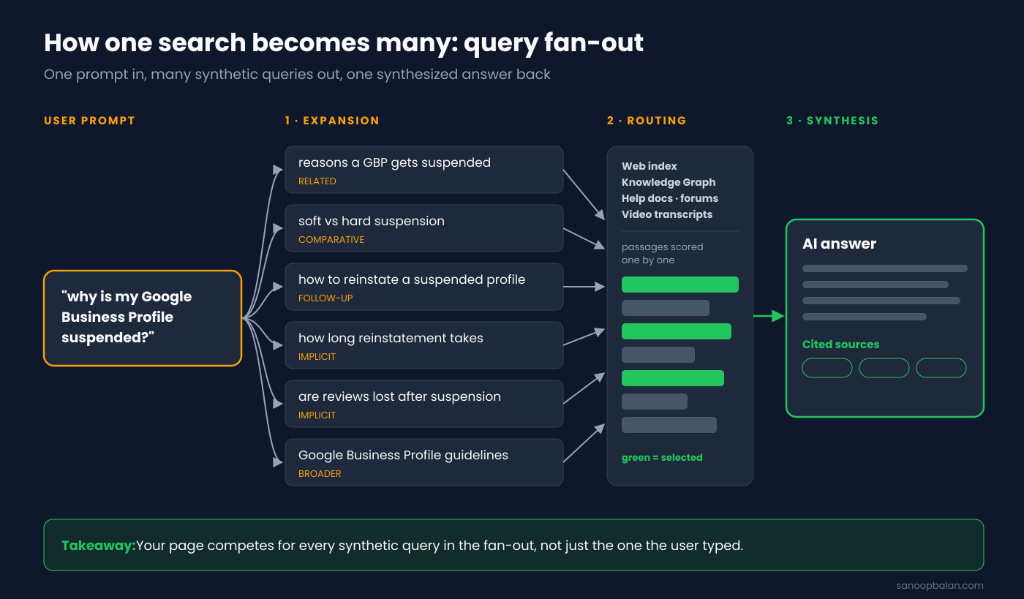
Figure 1. Query fan-out: one prompt is expanded into synthetic queries, routed to different sources, and synthesized into one cited answer.
Stage 1: Expansion: the AI turns one question into many
A large language model reads the prompt, works out the intent and generates sub-queries covering variables, alternatives and implicit follow-ups: the questions the user is likely to ask next but didn't type. For "best running shoes", that means queries about materials, durability, pronation support and price.
Google's patent filings describe this as query variant generation: a model is prompted to produce variants that emphasize different kinds of intent, and the set is filtered so the variants cover different angles instead of repeating each other.
Stage 2: Routing: each sub-query goes to the best source
Each synthetic query runs at the same time against whichever source suits it: the web index, the Knowledge Graph, structured data such as product and business listings, or video transcripts. Stein has said AI Mode can also use internal Google tools such as Google Finance. Running the queries in parallel keeps the answer fast even when the model researches many angles.
Stage 3: Synthesis: passages are extracted and stitched into one answer
Retrieved pages are split into passages, often called chunks. Practitioner analyses estimate these at roughly 200 to 500 tokens, about 150 to 375 words. Each passage is scored against its sub-query on its own merit, the strongest are selected, and the model writes the answer and cites a handful of sources.
What this means for your website
The AI isn't judging your page as a whole. It's judging the paragraph under your heading. A strong article with one vague, rambling section can lose that section's citation to a competitor whose single paragraph answers it better.
What types of synthetic queries does AI search generate?
Practitioners who have studied Google's patents and observed real fan-outs group synthetic queries into a handful of types. Labels vary by source, but the pattern is consistent:
| Type | What the AI is doing | Example for "why is my GBP suspended?" |
|---|---|---|
| Equivalent | Same intent, different wording | Google Business Profile suspension reason |
| Broader | Zooms out to the parent topic | Google Business Profile guidelines |
| Narrower | Zooms in on one angle | GBP suspended after changing address |
| Related | Explores an adjacent subtopic | GBP verification problems |
| Comparative | Weighs options against each other | soft vs hard suspension |
| Implicit | Answers a need the user didn't state | how long does reinstatement take |
| Follow-up | Predicts the next question | how to fill the reinstatement form |
| Personalized | Adapts to the user's context | GBP suspension help in Kerala |
Does every search trigger query fan-out?
No. Simple factual queries with one clear answer, such as "capital of France", usually don't need it. Fan-out is triggered by complex, exploratory or comparative prompts where one search can't cover the question. The number of sub-queries varies too: Ahrefs' research puts typical AI Mode fan-outs at roughly 5 to 11 queries, while Google has described its Deep Search mode as running far more.
Worked example: fanning out a real GBP query
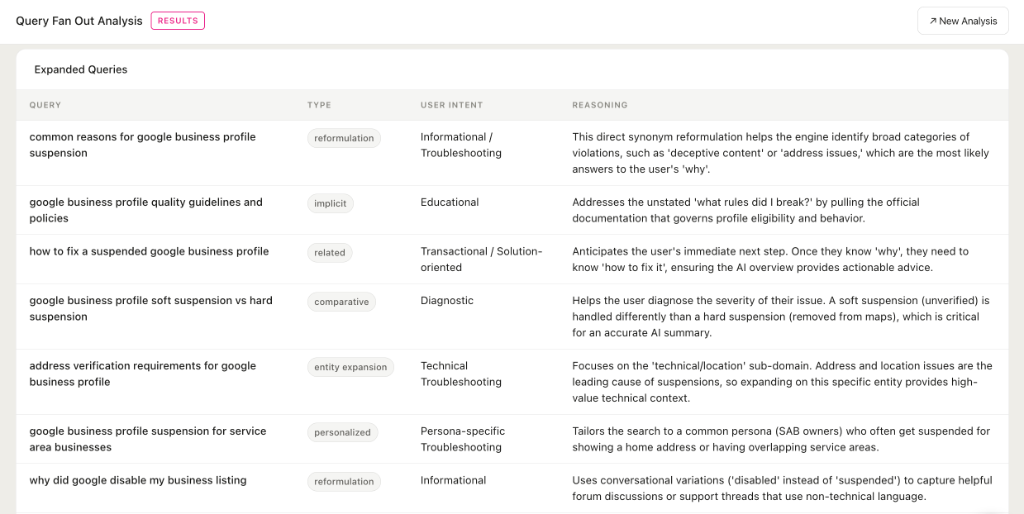
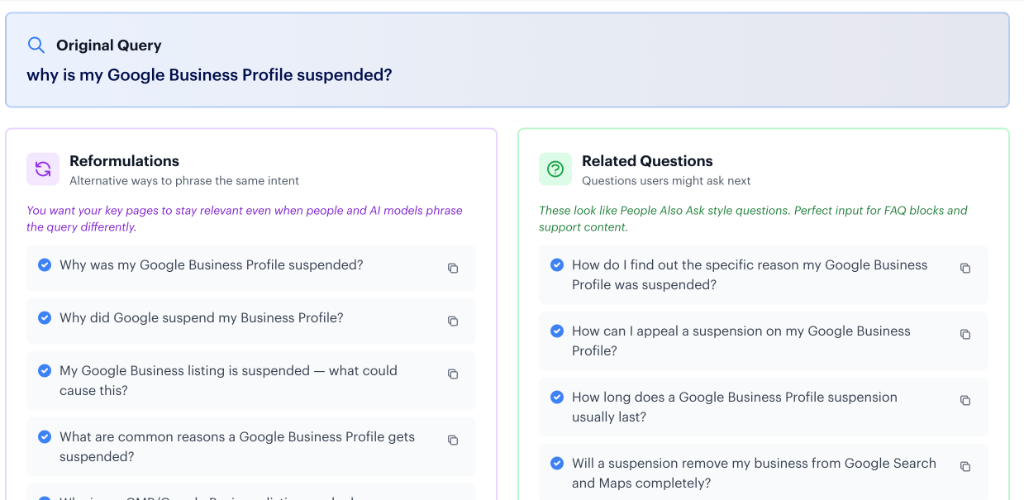
Here's how I apply this to a real query from my Google Business Profile work. The goal is to see which synthetic queries an existing article already answers, and where it leaves gaps.
- Start with the seed prompt: "why is my Google Business Profile suspended?"
- Run it through a fan-out simulator such as Qforia, and test the same prompt in ChatGPT with search turned on.
- Group the sub-queries by type using the table above, and merge near-duplicates.
- Map each sub-query to the section of the article that should answer it, and mark the gaps.
| Synthetic query | Section that should answer it | Status → action |
|---|---|---|
| reasons a GBP gets suspended | H2: Common reasons for suspension | Covered |
| soft vs hard suspension | H3: Soft vs hard suspension | Missing → add a comparison table |
| how long reinstatement takes | H3: Reinstatement timeline | Thin → add a direct answer first |
| are reviews lost after suspension | FAQ | Missing → add an FAQ answer |
| GBP suspension help in Kerala | Author box + local CTA | Covered |
Example: why is my Google Business Profile suspended?
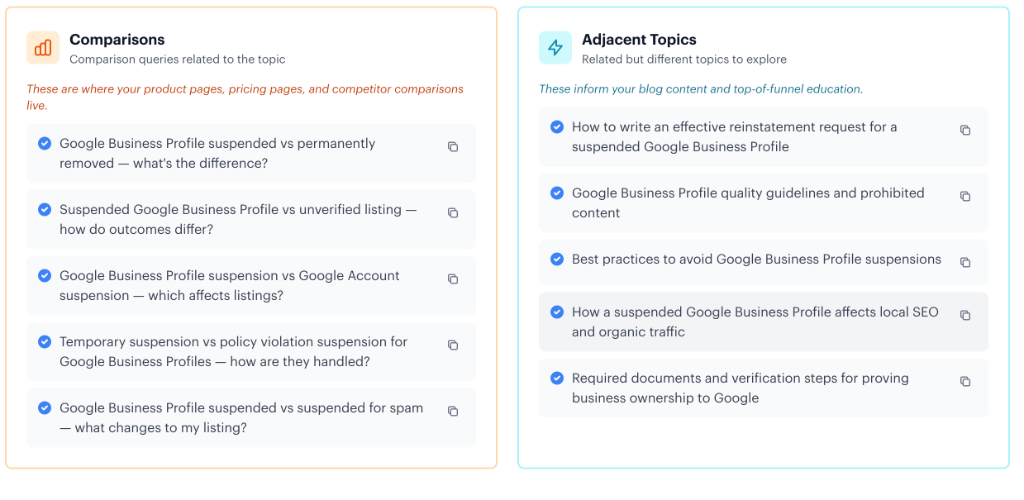
What has Google confirmed, and what is inferred?
Plenty of fan-out advice is built on patent speculation. Here's what's actually established:
| Claim | Status |
|---|---|
| AI Mode and AI Overviews use query fan-out | Confirmed by Google (AI Mode launch post, I/O 2025, Search Central documentation) |
| Fan-out runs multiple searches across subtopics and data sources | Confirmed by Google |
| Patents US20240289407A1 and "Thematic Search" (US12158907B1) describe the mechanism | Inferred. They closely match Google's descriptions, but a patent doesn't prove a feature is live, and the filings never use the phrase "query fan-out" |
| Passages of roughly 200–500 tokens are scored individually | Practitioner reconstruction. Widely observed, not officially specified |
| The exact number of sub-queries per prompt | Not published. It varies by query, system and user |
The lesson: be wary of anyone selling a "fan-out hack" based on a single patent. Optimize for the confirmed mechanics, which are coverage, clarity and extractable passages, and you're covered whatever the implementation details turn out to be.
Semantic SEO vs. Traditional SEO
If AI search breaks one question into many, a page built around one exact-match keyword only catches one of those queries. Semantic SEO is the fix: optimizing for the meaning of a topic, the entities in it and the relationships between them, so your content matches the whole fan-out rather than one phrase.
From keyword matching to meaning-based retrieval
Older retrieval leaned heavily on matching words. Modern systems convert queries and passages into embeddings, numerical representations of meaning, and retrieve passages that are close in meaning even when they share few exact words. That's why "GBP suspended" and "my business disappeared from Google Maps" can retrieve the same passage. This is meaning-based retrieval, and it's why keyword density has stopped being a useful lever.
What is semantic coverage?
Semantic coverage is how completely your content answers a topic's main question plus the implicit follow-ups around it. The higher your coverage, the more of an AI system's synthetic queries find a strong, matching passage on your page.
| Feature | Traditional SEO | Semantic SEO (AI search) |
|---|---|---|
| Targeting | Single primary keyword | Entire entity and topic cluster |
| Query origin | Typed directly by a human | Synthetic queries generated by AI |
| Unit of optimization | The page | The passage (chunk) |
| Goal | Rank the URL #1 on the SERP | Be selected during chunk selection and cited in the synthesis |
| Content strategy | Keyword density and word count | Semantic coverage and answering implicit follow-ups |
| Measurement | Rankings, CTR | Citations, brand mentions in AI answers, plus rankings |
The two aren't enemies. The same fundamentals, crawlable pages, clear structure and genuine expertise, still drive classic rankings, and AI search draws on the same index. Semantic SEO simply widens the target from one query to the whole cluster around it.
How to Optimize Your Website for Synthetic Queries
This is the seven-step workflow I use to make content ready for AI search. It works for a single blog post, a service page or a whole site.
Step 1: Find the synthetic queries for your topic
You can't see Google's fan-out directly, but you can get very close:
- Otterly, a free tool that simulates AI Mode and AI Overview fan-out using Gemini.
- ChatGPT search. Run your prompt with search on and inspect the search queries it ran. They appear in the page's network responses in your browser's developer tools (the exact method changes as the interface updates).
- Google's own surfaces. People Also Ask, AI Mode follow-up suggestions and related searches are useful real-world proxies.
- Google Search Console. Review your longest queries. Unusually long, structured phrasing is a useful prompt for a closer look.
To filter Search Console, go to Performance → Search results → + Add filter → Query → Custom (regex) and paste this pattern, which matches queries of six or more words:
^(\S+\s+){5,}\S+$The six-word cut-off is a practitioner rule of thumb, not a measured threshold. Guides such as Coupler.io's suggest it because machine-written queries often read long and structured, but no published dataset shows how many synthetic queries it catches or how many real searches it wrongly flags. Use it to surface queries worth a closer look, then judge each one: does it sound like something a person would type? Real users write long queries too, especially by voice.
Don't chase individual queries
Fan-out results change between runs, users and locations. Use synthetic queries to discover themes and gaps, not exact phrases to stuff into your copy.
Step 2: Build a query-to-section coverage matrix
List each synthetic query in a sheet with five columns: query, type, target section, status (covered / thin / missing) and action. The aim is to map sub-queries to sections, not to pages. Merge near-duplicates first: one strong section can answer several equivalent queries.
Step 3: Structure every section for chunk extraction
- Use question-led H2s and H3s that mirror how the sub-query is phrased.
- Answer first. The first one or two sentences under each heading should give the direct answer in about 40 to 60 words. Detail comes after.
- Make each section self-contained. Avoid "as mentioned above". Name the entity instead of writing "it", so the passage still makes sense when lifted out on its own.
- Keep one idea per section. Mixed sections produce weak, ambiguous chunks.
- Use tables and lists for comparisons, steps and specifications. They extract cleanly.
Here's the difference in practice:
Weak (not extractable)
"Coverage. This is something a lot of people misunderstand, and as we discussed earlier, it really matters, so let's look at it in more detail below."
Strong (extractable)
What is semantic coverage? Semantic coverage is how completely a page answers a topic's main question and its likely follow-ups. Higher coverage means more of an AI system's synthetic queries find a matching passage on your page.
Step 4: Answer the implicit follow-ups
For every main question, ask: what will this person want to know next? The usual implicit follow-ups are cost, time, risk, alternatives, suitability ("is this right for me?"), next steps and local availability. Give the important ones their own H3 and handle the short ones in an FAQ.
Step 5: Build tight topic clusters around entities
Entity understanding is how search systems recognize people, businesses, places and concepts and the relationships between them. Make those relationships obvious:
- Build a pillar page with supporting articles, linked with descriptive anchor text.
- Name your entities consistently across your site, Google Business Profile and social profiles.
- Connect your brand and author to authoritative identifiers such as Wikidata and your Knowledge Panel.
- Strengthen E-E-A-T on every page: a real author bio, first-hand evidence (screenshots, data, client examples), cited sources and a visible "last updated" date.
This article, for example, sits inside a Semantic SEO cluster alongside guides on seed queries, natural language queries, sequential queries and entity-seeking queries, each linking to the others.
Step 6: Leverage structured data
Google says there are no special technical requirements for appearing in AI features, and no special markup is needed. Structured data still helps machines understand your entities and how they connect, as long as it matches what's visible on the page. A solid stack for a blog post:
- BlogPosting (or Article) with an author that points to a Person entity, including sameAs links to Wikidata and LinkedIn.
- Organization or LocalBusiness for the business behind the content, especially for local SEO.
- FAQPage for genuine FAQ sections. FAQ rich results are now limited to a small set of sites, but the markup still describes your content clearly.
- BreadcrumbList to show where the page sits in your topic cluster.
Step 7: Measure your AI search visibility
- Keep a monthly log of your priority prompts in AI Mode, ChatGPT and Perplexity: are you cited, mentioned or absent?
- In Search Console, watch impressions on long queries over time. Google counts AI Mode and AI Overview clicks and impressions inside the standard Web search totals.
- In GA4, track referral traffic from
chatgpt.com,perplexity.aiandgemini.google.com. - Re-run your fan-out simulation after every major content update and compare coverage.
Common mistakes to avoid
- Stuffing every synthetic query phrase into the copy.
- Treating synthetic test prompts as if they were real search demand.
- Writing sections that only make sense if you read the whole page.
- Hiding the answer under a long introduction.
- Publishing unverified claims. AI systems compare multiple sources, and vague or unsupported statements are easy to discard.
The Future of Search
More searches now end without a click: the answer is on the results page, written by AI. In that world, the winning brands aren't the ones that rank for a single keyword. They're the ones whose passages answer the most synthetic queries, clearly and with evidence, from a source the AI can confidently identify.
That comes down to three things: semantic depth (cover the whole question), entity clarity (make it obvious who you are and what you know) and extractable structure (make every section stand on its own). None of these is a gamble on a patent. All three also help traditional rankings, which makes optimizing for synthetic queries a no-regret move.
Want to see how AI search reads your business?
I can map the fan-out for your most valuable queries and show you exactly which sections to add or fix.
Explore GEO & AEO Consulting in Kerala →Frequently Asked Questions
What is synthetic queries in SEO?
Synthetic queries are search queries generated by a machine rather than typed by a person. In SEO, the term usually means the hidden sub-queries that AI search systems such as Google AI Mode and ChatGPT create from a user's prompt to research every angle of the question before writing one answer.
Is query fan-out the same as synthetic queries?
Not quite. Query fan-out is the process; synthetic queries are what it produces. Fan-out expands one prompt into many synthetic queries, runs them in parallel and combines the results into one answer.
Can I see the synthetic queries Google generates?
Not directly. Google doesn't publish the fan-out for a given search. You can approximate it with simulators such as Qforia, by inspecting the queries ChatGPT runs during a search, and by studying People Also Ask and related searches.
Do synthetic queries show up in Google Search Console?
Some long, machine-sounding queries in Search Console may come from automated systems. Filtering for queries of six or more words is a quick way to review them, but long queries can also come from real users, so treat the filter as a signal rather than proof.
Do I need special schema to appear in AI Overviews?
No. Google says no special markup is required for AI features. Structured data such as Article, Person, Organization and FAQPage still helps search systems understand your entities, provided it matches the visible content.
Does every Google search use query fan-out?
No. Simple factual questions with one clear answer usually don't need it. Fan-out is used for complex, exploratory or comparative prompts that a single search can't fully answer.
About the Author
Sanoop Balan is a Digital Marketing Strategist and SEO Expert based in Kozhikode, Kerala. He helps businesses in Kerala and the GCC grow through Local SEO, Google Business Profile optimization, AEO and GEO, and has trained more than 1,000 digital marketing students. Connect on LinkedIn or get in touch via Contact.
References
- Google Search Central: AI features and your website
- Search Engine Journal: Query Fan-Out Technique in AI Mode: New Details From Google
- Ahrefs: What is Query Fan-Out?
- Coupler.io: Detecting Synthetic Queries in Google Search Console
- Majestic, SEO in 2026: Lazarina Stoy
- GEO Toolbox: Query Fan-Out (terminology and patents)
- Google Patents: US20240289407A1
- Google Patents: US12158907B1 (Thematic Search)