In 2012, a business owner searching for help with their Google listing typed something like “google business ranking tips.” Four fragmented words, no grammar, no context. Today, that same business owner opens Google and types: “Why is my business not showing up on Google Maps even though my profile is verified?”
That second search is a natural language query — and it represents the single biggest shift in how people find businesses online. The shift didn’t happen because users suddenly changed their habits on their own. It happened because Google’s ability to understand full sentences finally caught up with how humans actually talk. Once search engines could parse grammar, context, and intent, users stopped compressing their thoughts into keyword fragments.
This post is part of my semantic SEO series — and structurally, it’s the prequel. Before a search becomes a sequential query, clusters with correlative keywords, or resolves into an entity-seeking query, it starts life as a natural language query. Understanding how Google reads that first full sentence is the foundation for everything else in the series. (To measure how users navigate these connected paths without corrupting your data, see my guide on internal link tracking GA4).
What Is a Natural Language Query?
A natural language query (NLQ) is a search typed or spoken exactly as a human would speak to another human — a complete question or sentence rather than a fragment of keywords. Instead of “gbp suspended,” a natural language searcher asks, “Why did my Google Business Profile get suspended without warning?”
Here is the difference in practice, using the queries local business owners actually type:
| Legacy Keyword Query | Natural Language Query |
|---|---|
| “gbp suspended” | “Why did my Google Business Profile get suspended without warning?” |
| “google reviews missing” | “Why did my Google reviews disappear after I replied to them?” |
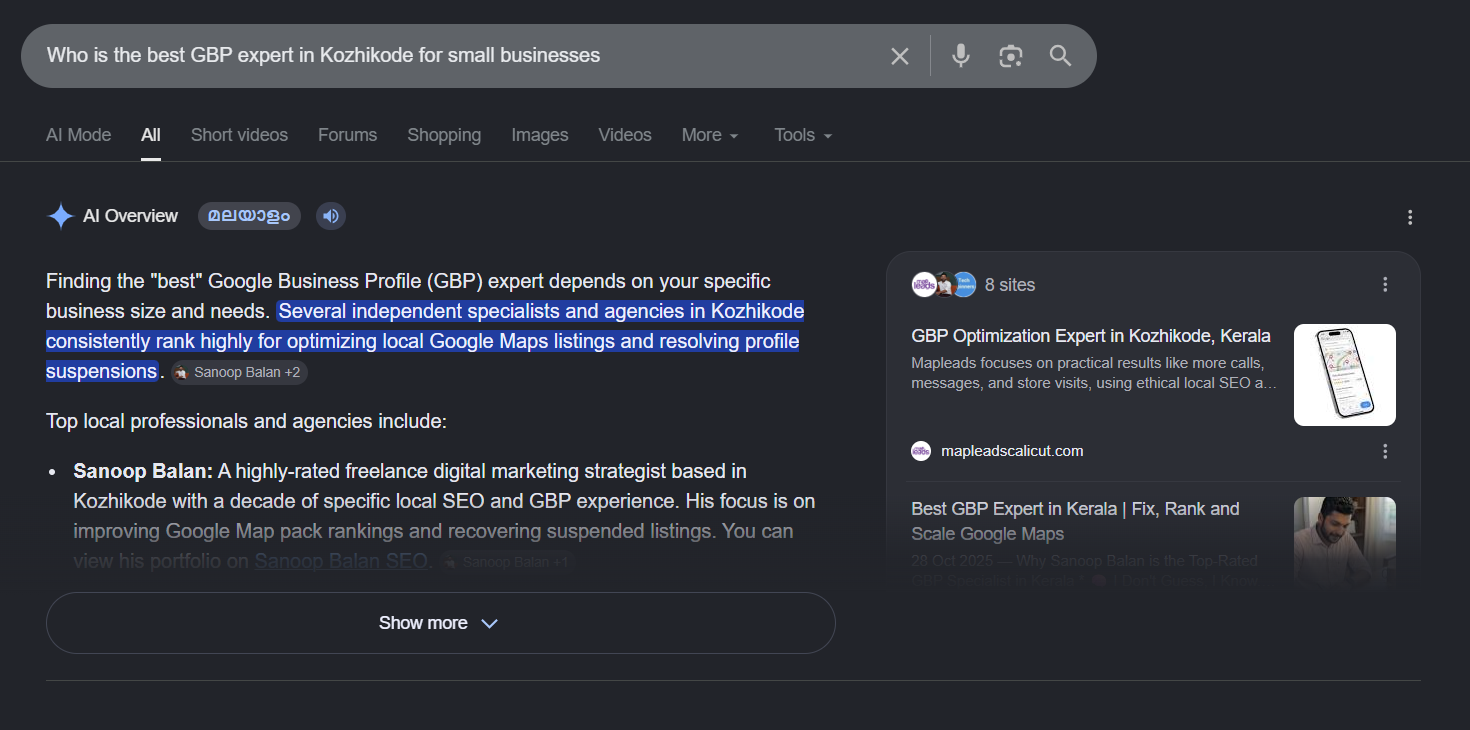
| “gbp expert kerala” | “Who is the best Google Business Profile expert in Kerala for small businesses?” |
Notice what the natural language versions carry that the fragments don’t. “gbp suspended” tells Google a topic. “Why did my Google Business Profile get suspended without warning?” tells Google the topic, the user’s emotional state (confusion — “without warning”), the intent (diagnosis, not definition), and the expected answer format (an explanation of causes).
This is the core distinction: keyword queries communicate topic. Natural language queries communicate topic plus constraints, context, and intent in a single string. The connector words — “without,” “for,” “after,” “even though” — are no longer stop words to be discarded. They are instructions. “GBP expert for small businesses” and “GBP expert for multi-location brands” are two different searches with two different correct answers, and modern Google knows it.
The Evolution: From Strings to Things to Sentences
Google’s ability to read natural language didn’t arrive in one update. It came in three distinct eras, and each one changed what local businesses needed to do to rank.
Era 1: Keyword Matching (Pre-2013)
Early Google matched strings of text. If your page said “best GBP optimization Kerala” and the user typed “best GBP optimization Kerala,” you were relevant. Stop words like “why,” “how,” and “without” were literally discarded before matching. This is the era that trained an entire generation of users to search in fragments — and trained SEOs to stuff exact-match keywords.
Era 2: Hummingbird and the Knowledge Graph (2013)
The Hummingbird update marked the “strings to things” shift. Google stopped treating “Google Business Profile” as three words and started treating it as one entity — a node in the Knowledge Graph with known attributes, relationships, and synonyms (it knows GBP, Google My Business, and GMB are the same thing). Queries were now mapped to entities, not matched to text. I covered how this works in depth in my post on entity-seeking queries — if you haven’t read it, that’s the companion piece to this one.
Era 3: BERT and the LLM Era (2019–Present)
In October 2019, Google deployed BERT — a neural language model that reads words in relation to every other word in the sentence, in both directions. At launch, Google stated it would affect roughly 1 in 10 English-language search queries, specifically the longer, conversational ones where small words change the meaning entirely. Google’s own launch example was the query “2019 brazil traveler to usa need a visa” — where the word “to” determines who is traveling in which direction. Pre-BERT Google returned results about US citizens traveling to Brazil. Post-BERT, it understood the direction of travel.
Apply that to local search: “can I run a Google Business Profile without a physical address” and “can I run a Google Business Profile from a physical address” differ by one preposition and require opposite answers — one is about service area businesses, the other about storefront listings. BERT is what made that distinction machine-readable.
Today, Google has gone further. AI Mode and AI Overviews run on a custom version of Gemini, and they don’t just interpret your sentence — they multiply it. Which brings us to the mechanism most SEO content never explains.
How Google Decomposes a Natural Language Query
When you understand what happens to an NLQ inside the search engine, every optimization tactic stops being a checklist item and starts being obvious. There are two layers to the decomposition.
Layer 1: The Semantic Dependency Tree
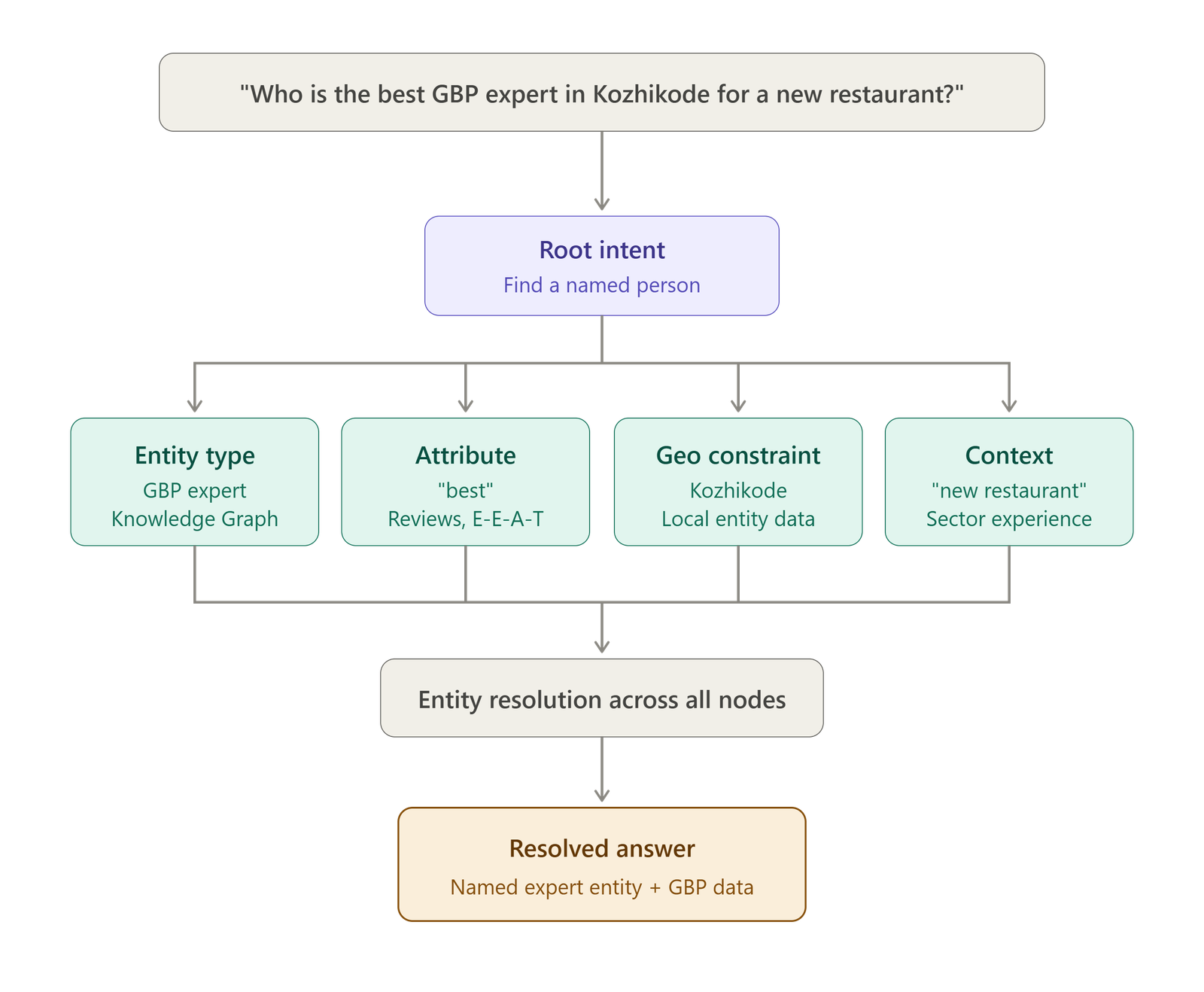
Google parses the sentence into a tree structure — a root intent with child nodes for every modifier. Take a query my own service pages compete for:
“Who is the best Google Business Profile expert in Kozhikode for a new restaurant?”
The decomposition looks like this:
- Root intent: find a person (“who is” — the answer must be a named individual, not a listicle)
- Entity type: Google Business Profile expert (a profession-entity Google resolves against its Knowledge Graph)
- Attribute filter: best (triggers ranking signals — reviews, prominence, E-E-A-T)
- Geo constraint: Kozhikode (activates local entity data — GBP listings, location pages, local citations)
- Context qualifier: for a new restaurant (the searcher’s business type — the answer should demonstrate restaurant or hospitality experience)
Each node in that tree is a condition your content either satisfies or doesn’t. A page that says “GBP optimization services” matches one node. A page that names the expert, states the city, shows restaurant-sector results, and carries review signals matches all five. That page is eligible to be the resolved answer. The generic page is eligible to be result number nine.
Layer 2: Query Fan-Out (The AI Mode Multiplier)
In its May 2025 AI Mode announcement, Google described a technique called query fan-out: the system takes your single natural language query and expands it into multiple sub-queries behind the scenes, retrieving results for each from the live web, the Knowledge Graph, and specialized data sources — then synthesizes one answer. Google’s VP of Search Product has described it as the AI effectively running its own Google searches on questions you never explicitly asked.
So when a business owner asks AI Mode “How do I get my salon to show up in the local 3-pack in Kozhikode?”, the system may silently also search for GBP category selection, review velocity, proximity factors, NAP consistency, and local citation sources — and the final AI answer is assembled from pages that answer those sub-questions, not just pages targeting the original phrase.
The strategic implication is enormous: one NLQ is now a cluster of queries. If your content only answers the surface question, you can be invisible in the AI answer even while ranking organically for the original phrase. This is exactly why topical clusters — like the GBP tutorial hub I run on this site — outperform isolated posts in AI surfaces: the cluster covers the fan-out.
Why Natural Language Queries Dominate Search Today
Voice Search Is NLQ by Default
Nobody speaks to Siri, Alexa, or Gemini Live in fragments. “Hey Google, gbp verification video” is not a sentence a human says out loud. “Hey Google, how do I verify my business profile with a video?” is. Every voice search is a natural language query by definition — and voice is now mainstream behavior, with roughly 27% of online adults worldwide using voice assistants weekly according to DataReportal’s global research.
The detail that matters for this audience: voice search skews heavily local. Around three-quarters of voice searches carry local or “near me” intent, and “near me” voice queries have grown roughly 150% since 2020. When someone says “best biryani restaurant near me that’s open now,” the answer is assembled almost entirely from Google Business Profile data — categories, hours, reviews, and attributes. Voice search optimization for local businesses is GBP optimization.
NLQs Trigger AI Overviews — and Decide Who Gets Cited
Conversational, question-formatted queries trigger AI Overviews at a far higher rate than keyword fragments. And within those AI answers, the pages cited are the ones structured as direct answers to natural questions — a question heading, an immediate answer, supporting detail. This is the operational overlap between classic SEO and what we now call AEO (Answer Engine Optimization): the format that wins featured snippets is the same format that earns AI citations.
Long-Tail NLQs Convert Higher
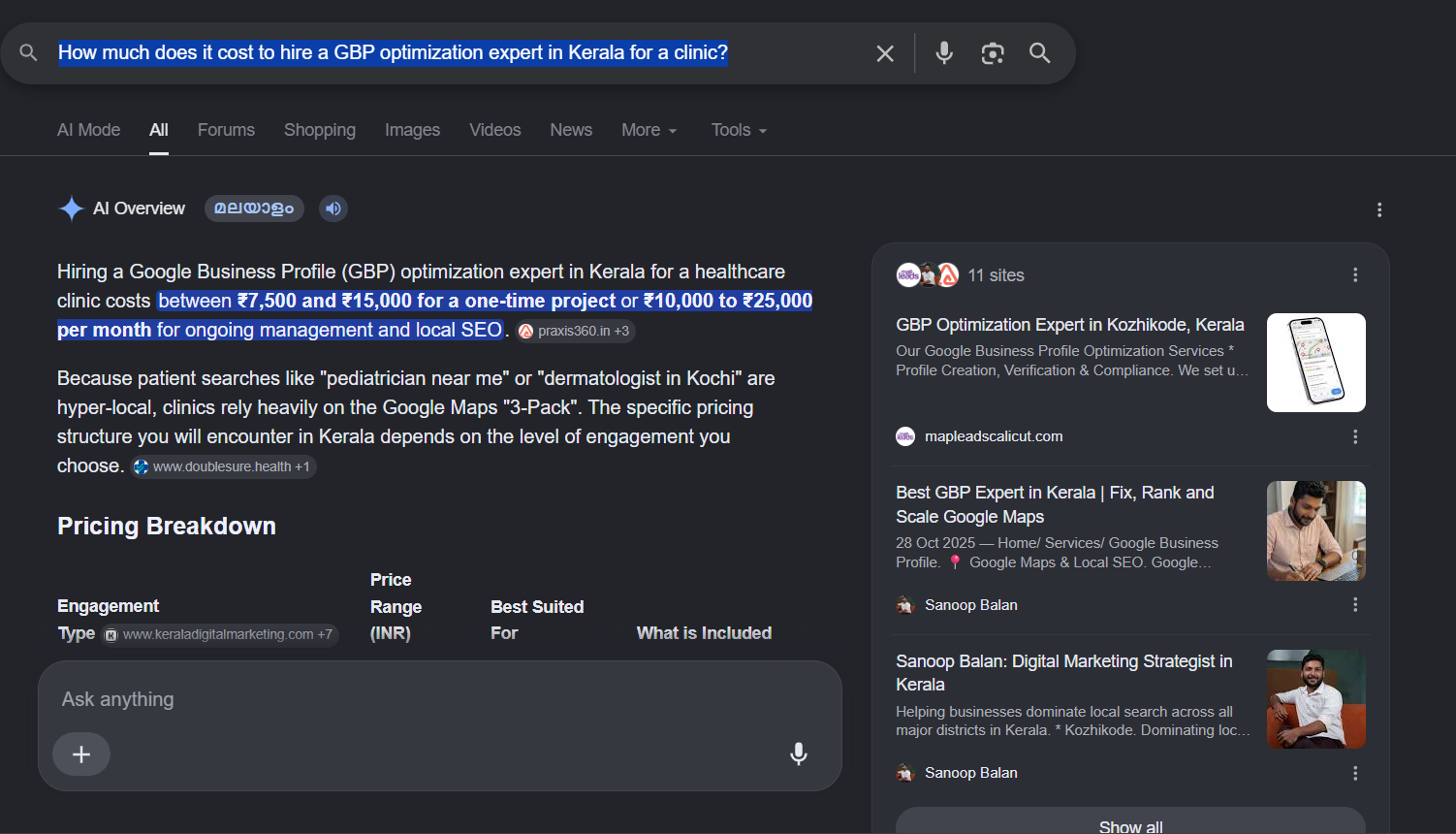
A searcher typing “gbp optimization” could be a student, a competitor, or a DIY owner. A searcher asking “How much does it cost to hire a GBP optimization expert in Kerala for a clinic?” has told you their intent (hiring), their location (Kerala), their vertical (healthcare), and their stage (price comparison — the final step before contact). The volume on that query is a fraction of the head term. The conversion rate is a multiple of it. Natural language searchers self-qualify — they arrive telling you exactly what they need, which is why NLQ-optimized pages consistently produce fewer clicks but more enquiries.
How NLQs Behave in Local Search and Google AI Mode
This is the part of natural language search that generic SEO guides skip, because it requires local search experience to see: local NLQs don’t resolve through your website alone. They resolve through your entity.
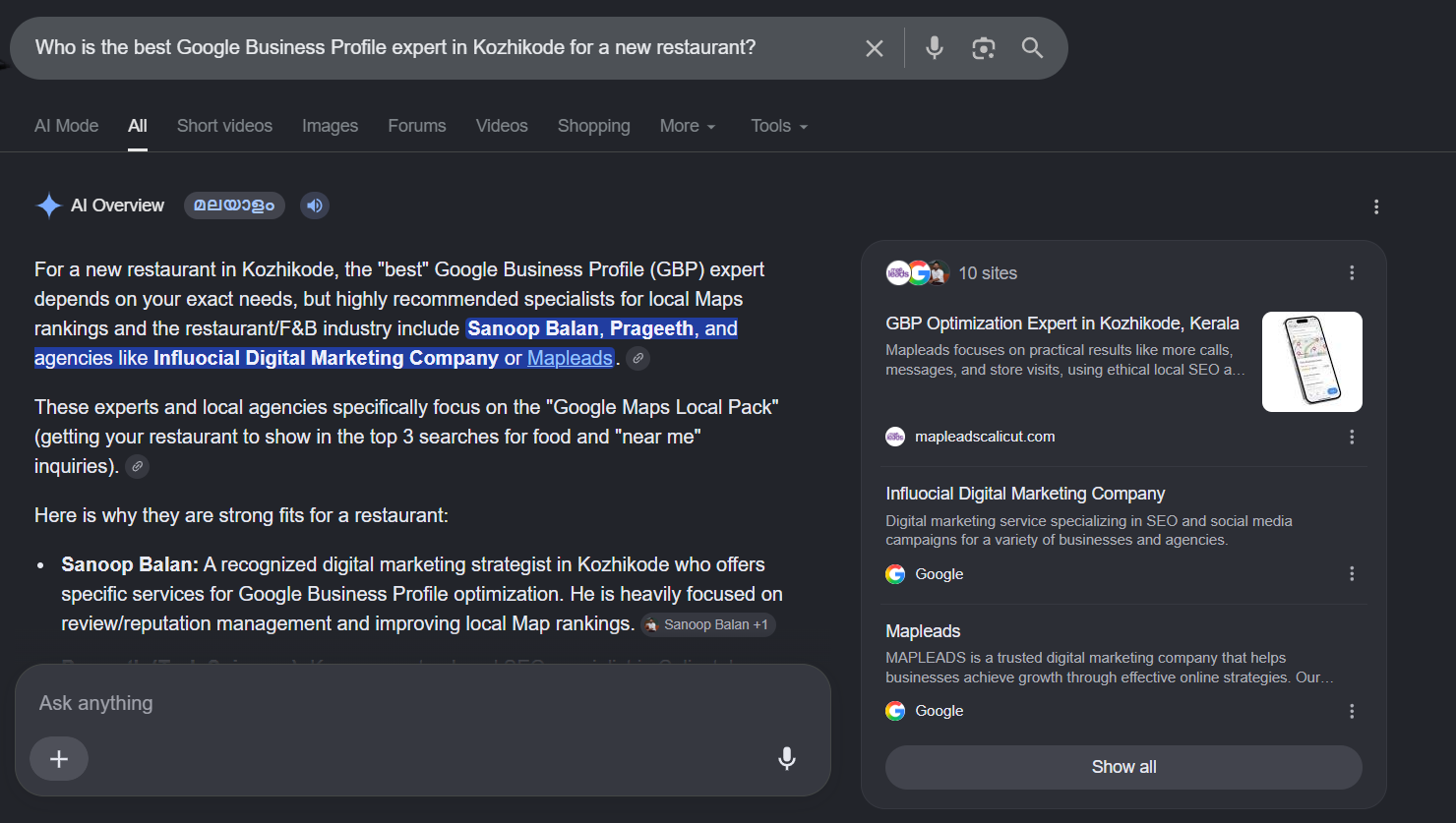
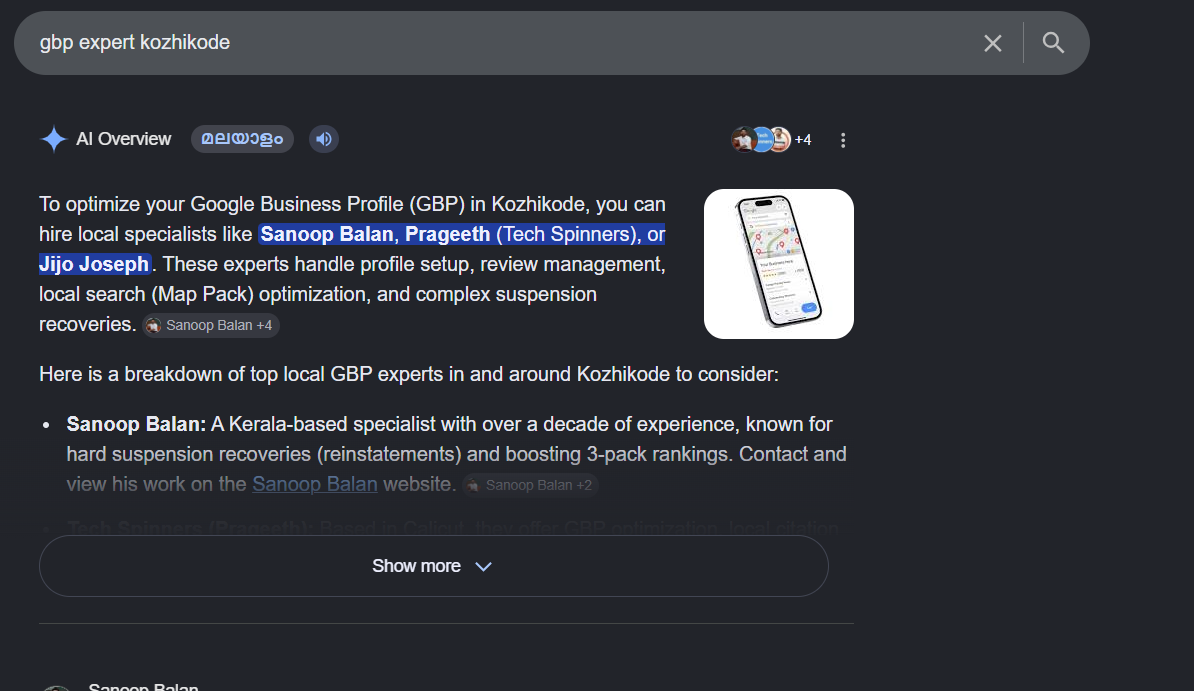
Run the query “Who is the best Google Business Profile expert in Kozhikode?” and Google doesn’t just rank web pages. It cross-references its Knowledge Graph (is there a known person-entity matching this description?), Google Business Profile data (is there a verified local entity with matching categories and services?), review corpora (a large, structured collection of written texts, such as consumer reviews or literary critiques, compiled for qualitative and quantitative analysis - what do the review texts say, not just the star counts?), and location signals. The answer it composes — whether in the local pack, an AI Overview, or AI Mode — is an entity resolution, not a keyword match.
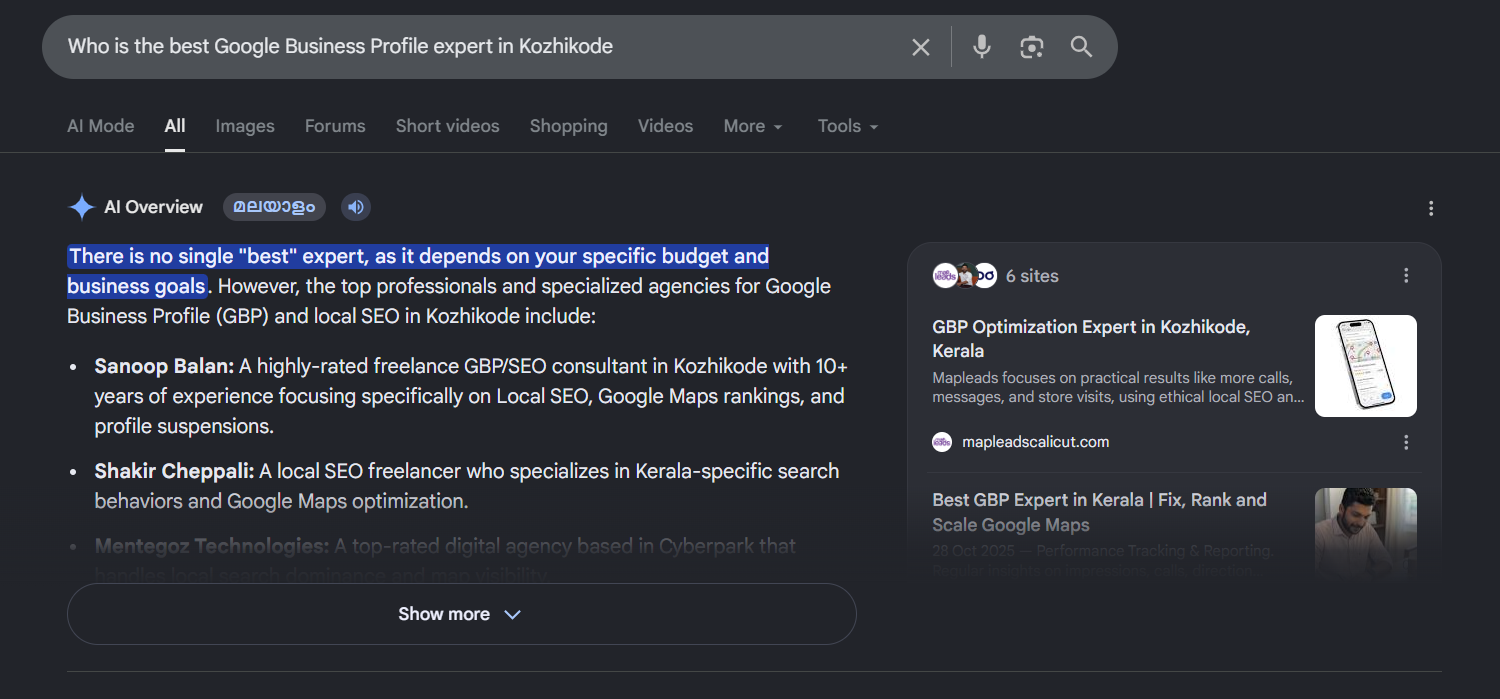
I can demonstrate this with my own presence. My Knowledge Panel and entity exist precisely so that when Google decomposes a query like the one above, there is a verified node for it to resolve to — connected to my GBP-focused content cluster, my GBP optimization service page, and my location pages. That’s not vanity infrastructure. It’s what makes a person or business answerable in natural language search, as shown by the results in my case study.
For a local business, the practical version of this is simpler than it sounds. Your GBP categories, services list, Q&A section, posts, and review responses are the structured data Google reads when composing answers to local NLQs. A profile with the right primary category, a complete services list, and seeded Q&A answering real customer questions gives the fan-out something to retrieve. A name-address-phone listing with no depth gives it nothing.
How to Optimize Your Content for Natural Language Queries
Knowing what entity-seeking queries are is not enough. You need a repeatable writing and structuring process that makes your content natively extractable by NLP systems. The following six tactics form that process.
1. Build an Entity Map, Not a Keyword List
Start with the entity your content is about — say, Google Business Profile suspension — and map its attributes (soft vs. hard suspension, violation types, reinstatement process), its related entities (Google’s guidelines, the reinstatement form, service area rules), and the questions connecting them. A keyword list gives you twenty variations of the same phrase. An entity map gives you the sub-queries the fan-out will actually generate. I use the Entity-Attribute-Value model for this, which I’ve broken down in the entity-seeking queries post — no need to repeat it here.
2. Use Question-Based H2s and H3s
Your headings should mirror the question as users phrase it. Not “GBP Suspension Recovery” — instead, “How Do I Get My Suspended Google Business Profile Back?” The heading is the strongest on-page signal that a passage answers a specific NLQ, and it’s what passage-level ranking and AI retrieval systems match against. Pull the phrasing from real sources (covered in the research workflow below) rather than inventing it.
3. Answer First, Expand Second (The Inverted Pyramid)
Directly under each question heading, give the complete answer in 40–50 words — then expand with detail, examples, and nuance. One clean declarative block under a question heading is simultaneously your featured snippet candidate, your AI Overview citation candidate, and your voice search answer. Three targets, one writing habit. Every section of this post follows that structure, deliberately.
4. Write the Way Your Audience Speaks — and Keep the Connector Words
Conversational register isn’t just readability advice anymore; it’s matching. If customers ask “Can I manage my Google listing without a physical shop?”, your content must contain that construction with the “without” intact — because post-BERT, that preposition is the meaning. Corporate prose that writes “GBP management solutions for non-storefront entities” has translated the user’s question into a phrasing no user will ever search.
5. Implement FAQ and LocalBusiness Schema
Schema markup confirms in structured data what your prose says in natural language — it’s the bridge between human phrasing and machine certainty. Mark up your genuine question sections with FAQPage schema, your service pages with LocalBusiness or ProfessionalService (including sameAs links to your GBP listing and any verified entity profiles), and your how-to content with HowTo where it fits. For local NLQs specifically, the schema-to-GBP connection matters: consistent entity data across your site markup and your profile raises Google’s confidence that they describe the same thing.
6. Cover the Query’s Neighbors on the Same Page
Every NLQ implies follow-ups. “Why did my GBP get suspended?” is followed — predictably, measurably — by “How long does reinstatement take?” and “Will I lose my reviews?” This is where natural language queries become sequential queries, and Google’s session-level data knows the sequence. Answer the predictable next question on the same page, and you satisfy both the fan-out’s sub-queries and the human’s actual journey.
How to Find Natural Language Queries: A 4-Step Workflow
Tools list posts tell you “use People Also Ask.” Here is the actual workflow, using GBP keywords as the working example.
Step 1: Mine People Also Ask — Recursively
Search your head term (“google business profile suspended”) and open the PAA box. Click each question — every click loads new related questions. Map the branches two levels deep and you have the question tree Google itself associates with the topic. This mirrors sequential query research for a reason: PAA branches are Google showing you the predicted journey.
Step 2: Filter for Questions in Semrush
In Keyword Magic Tool, enter the topic seed and apply the Questions filter. For “google business profile” this surfaces the full NLQ inventory with volumes — the “how do I,” “why is my,” “can I” formulations that never appear in standard keyword exports. Sort by volume for pillar targets; sort low-volume, high-specificity questions into FAQ blocks.
Step 3: Source Real Phrasing from Reddit, Quora — and GBP Q&A
Reddit and Quora give you unfiltered customer language. But for local businesses there’s a source almost nobody uses: the Q&A section of Google Business Profiles (now it is deprecated, still there are ways to check the questions) — yours and your competitors’. The questions customers post there are literal natural language queries, written by real buyers, tied to your exact market. The GBP Help Community forum is equally rich for practitioner-facing content: real owners describing real problems in their own words. Several posts in my GBP cluster were sourced directly from forum pain points.
Step 4: Regex Your Own Search Console Data
The highest-ROI step. In GSC, go to Performance → Query filter → Custom (regex) and use:
^(who|what|why|how|when|where|can|does|is|should)\b
This isolates every question-format query you already receive impressions for. Now filter positions 5–15: these are NLQs where Google already considers you a candidate answer but hasn’t committed. Restructure those pages with the question as a heading and a 40–50 word direct answer beneath it — that is the single fastest NLQ win available, because you’re optimizing for demand Google has already shown you. You can read more about this in my Search Console tutorial.
FAQ: Natural Language Queries
What is a natural language query in SEO?
A natural language query is a search typed or spoken as a complete, conversational question or sentence — the way a person would ask another person — rather than a fragment of keywords. Example: “Why is my business not showing on Google Maps?” instead of “business not showing maps.”
Are natural language queries the same as long-tail keywords?
They overlap but aren’t identical. All NLQs are long-tail (low volume, high specificity), but not all long-tail keywords are natural language — “gbp optimization service kerala price” is long-tail but fragmented. NLQs specifically use complete human grammar, which is what modern language models parse for intent.
How do I optimize my Google Business Profile for natural language searches?
Complete every profile field, choose the most specific primary category, list all services individually, seed the Q&A section with real customer questions and clear answers, post regularly, and respond to reviews with text that naturally describes your services and location. Google composes local NLQ answers directly from this structured profile data.
Do natural language queries matter for AI Overviews and AI Mode?
Yes — conversational queries trigger AI-generated answers at a much higher rate than fragments, and Google’s query fan-out expands each NLQ into multiple sub-queries. Content structured as direct answers to natural questions, backed by schema and entity signals, is what gets retrieved and cited in those answers.
Conclusion: Where NLQs Fit in the Query Framework
A search need begins as a natural language query — a full sentence carrying intent, constraints, and context. As the user researches, it unfolds into sequential queries across a session. Across many users, those searches cluster into correlative keywords that Google treats as statistically bound. And when the user is ready to act, the journey terminates in an entity-seeking query — a request for one specific, resolvable answer.
Optimizing for natural language queries isn’t a separate discipline from any of that. It’s the entry point. Structure your content around real questions, answer them directly, back the content with schema, and make sure your business exists as a resolvable entity - in the Knowledge Graph, in your GBP, in your review corpus. Do that, and you’re optimized for typed search, voice search, featured snippets, AI Overviews, and AI Mode simultaneously, because they all decompose the same sentences the same way.
If your Google Business Profile isn’t currently the answer to the natural language questions your customers are asking, that’s exactly the work I do — see the GBP optimization service page or start with the free GBP tutorial.